Prep for an online class doesn't end once the course is initially complete and delivered that first time. As in the traditional classroom, there's always room for improvement. Every act of preparation requires time and effort. It's not like in the f2f classroom, where you can come up with an idea on the fly and give it a try to see if it works. Every act must be intentional and the steps for each act must be carefully planned and prepared.
Every semester I choose one thing to improve, even if there are a gazillion things that need help. Because of the time commitment, I find that any improvement I make needs to be ready before the class starts because once that happens, all my time goes into my students.
This this current semester, for example, I took something I learned delivering the curriculum from the masters-level academic writing course I teach, and incorporated into my undergrad composition class.
In the graduate-level class, students journal about what they read and start to connect the theories of the readings into practice in their writing. One thing I noticed about the online freshman composition class I teach, is that there is no grammar component in the class. My masters-level students have often lamented in their journals that the grammar and style concepts they were learning should have been taught to them in undergrad. Knowing this, I decided to transfer this concept to my freshman, hoping that they'd see a benefit in journaling about what they read. While there are still many changes I'd like to make to the course, this was the change I thought would be most beneficial to my students, so I went with it. If it's successful, I'll leave it in the curriculum, and if it's not, I'll either modify it or discontinue this exercise.
Another improvement I'd like to make in my online classes is to add weekly podcasts to the announcements. Preparing podcasts can be extremely time consuming. Personally, I can't just sit down and record--I need to write a script first. I record using Audacity, which allows me to edit out any bumbles I make. So far, the majority of my podcasts have been introductory to give students another way to get to know me as an instructor. One summer semester, I recorded a podcast for each week. I'm not sure how effective they were, or how necessary, but for some students, hearing instructions in addition to reading them can be beneficial.
Composition classes are scary for many students, so I like to convey an open and relaxed atmosphere to empower students to write instead of worrying how I'm going to react to their writing. I would like to create more effective assignments and podcasts in the future to further enhance my current curriculum.
Showing posts with label online classes. Show all posts
Showing posts with label online classes. Show all posts
Thursday, April 8, 2010


Monday, April 5, 2010
What is Online Learning and How Much Easier is it Than Face to Face?
A key ingredient for online learning is MOTIVATION. Because students don’t have to be at a specific place at a specific time, it’s easy for them to forget the online class exists. I recently read a blog post on Teaching Online where the virtual professor talked about adult learning environments being “learner-centered education that guides learners to be self-directed and independent in their learning.” The desired end result in such an environment is that students and teachers become equal partners in the learning process. This to me is a perfect description of online learning
Sometimes students don't realize how reading- and writing intensive online classes are. Students need to self-evaluate to determine if this format will work for them.
One way to change the perception that online=easy is for instructors to be clear and up front about the time commitment necessary and how the way one operates in an online setting is totally different than the traditional classroom.
When instructors are clear about their expectations, serious students will be motivated to think about their schedule and how they will fit the level of interaction necessary to succeed into what is likely a pretty busy lifestyle.
I, for one, am often at the mercy of my kids and my students (and my husband, and the laundry/dishes/house, and the kids a little more). It's kind of scary to be committed to teaching and taking an online class because there will be days (like today) where I can cyber stalk the discussion boards, but there may be others where I'm so busy that I miss that 48 hour window.
Do how do students/teachers get organized?
One of the first things I tell my online students is to get a calendar and write down due dates for all assignments for not only my course and their other courses, but also their other commitments in life. There's a healthy population of young adults out there who don't know how to manage a calendar.
Weekly announcements help as well. I try to be friendly and conversational in them as I remind them of the week's due dates and to look ahead to next week.
This will not guarantee a student will be successful in an online course; however, being clear about expectations and helping students get organized are two important factors in achieving success in an online class.
Sometimes students don't realize how reading- and writing intensive online classes are. Students need to self-evaluate to determine if this format will work for them.
One way to change the perception that online=easy is for instructors to be clear and up front about the time commitment necessary and how the way one operates in an online setting is totally different than the traditional classroom.
When instructors are clear about their expectations, serious students will be motivated to think about their schedule and how they will fit the level of interaction necessary to succeed into what is likely a pretty busy lifestyle.
I, for one, am often at the mercy of my kids and my students (and my husband, and the laundry/dishes/house, and the kids a little more). It's kind of scary to be committed to teaching and taking an online class because there will be days (like today) where I can cyber stalk the discussion boards, but there may be others where I'm so busy that I miss that 48 hour window.
Do how do students/teachers get organized?
One of the first things I tell my online students is to get a calendar and write down due dates for all assignments for not only my course and their other courses, but also their other commitments in life. There's a healthy population of young adults out there who don't know how to manage a calendar.
Weekly announcements help as well. I try to be friendly and conversational in them as I remind them of the week's due dates and to look ahead to next week.
This will not guarantee a student will be successful in an online course; however, being clear about expectations and helping students get organized are two important factors in achieving success in an online class.
Sunday, April 4, 2010
Continuing My Own Education, Part 2
Having gotten my first F2F class on the other side of the podium under my belt, I decided to pursue something more. It started with a conversation with the woman who teaches before me in the computer lab on Thursday nights. JJ and I have about 40 minutes each week to shoot the breeze about English 1101 and other teaching topics between class meetings.
JJ told me about the Illinois Online Network, where I can pursue a Master Online Teacher Certificate where else but online. What is particularly cool about this program is because I'm a part of the College of DuPage faculty (a COD faculty member helped design this program), tuition is only $60 per class.
In this program, I will take four core classes that are fully online and 8-weeks long. There's also one elective and a practicum that needs to be completed. I started my first class, "Online Learning: An Overview," earlier this week and I'm loving it.
I've been online grading a lot this week and have more time to devote than usual, so I've been quite the over-achiever on the message boards. I hope my classmates don't think I'm a total suck-up. I'm simply deprived of conversation with other adults in my field. I've been deprived for a very long time, so I'm really enjoying connecting with my peers in the field.
I certainly don't have the time for these classes, but I'm so incredibly motivated right now that I'm MAKING the time. It's such a creative outlet for me and it's inspiring me to make time to reach my own personal writing and teaching goals instead of always focusing on the needs and goals of others. It's a nice change.
Related links: Continuing My Own Education, Part 1
JJ told me about the Illinois Online Network, where I can pursue a Master Online Teacher Certificate where else but online. What is particularly cool about this program is because I'm a part of the College of DuPage faculty (a COD faculty member helped design this program), tuition is only $60 per class.
In this program, I will take four core classes that are fully online and 8-weeks long. There's also one elective and a practicum that needs to be completed. I started my first class, "Online Learning: An Overview," earlier this week and I'm loving it.
I've been online grading a lot this week and have more time to devote than usual, so I've been quite the over-achiever on the message boards. I hope my classmates don't think I'm a total suck-up. I'm simply deprived of conversation with other adults in my field. I've been deprived for a very long time, so I'm really enjoying connecting with my peers in the field.
I certainly don't have the time for these classes, but I'm so incredibly motivated right now that I'm MAKING the time. It's such a creative outlet for me and it's inspiring me to make time to reach my own personal writing and teaching goals instead of always focusing on the needs and goals of others. It's a nice change.
Related links: Continuing My Own Education, Part 1
Friday, March 26, 2010
Continuing My Own Education
I've been teaching for nearly 10 years and I've recently gotten the go-back-to-school bug. With two young kids and a full teaching schedule, pursuing another degree is not appealing. I really don't want a doctorate in this point in my career and I can't really think of a master's program that I want to enroll in (or pay for). But recently at College of DuPage, I got an email about an opportunity to take a graduate-level class through Aurora University for $325--INCLUDING the book.
I didn't think I could ever beat that price, and the subject was of interest--teaching studentes for the workplace. So a month ago, I attended my first class.
I love it. The discussion is stimulating and the instructor is open-minded. Everything we do in this class serves a greater purpose: to apply new ways of teaching to a specific class I'm teaching. How cool is that!
Right now I'm working on a resource website that I'm creating as an assignment called the Writing Resources Toolbox. In it I'm creating links to tools and resources for my students and for other instructors.
The student section has (or will have) both a Grammar Toolbox and a Writing Style Toolbox. The toolboxes will contain links to webpages and interactive exercises to help students brush up on grammar- and style-related issues in their writing.
The instructor section is the most exciting for me and includes Social Media Resources, Google Apps Resources, Additional Online Resources, and Web 2.0 Resources. I'm also hoping to create sections for Using Blackboard Effectively and Writing Assignments.
I'm most excited about this section. Basically, whenever I'm in my reader reviewing my favorite blogs (like Teach Online, Free Technology for Teachers, and Blogging about the Web 2.0 Connected Classroom), I add a link to anything useful out there that I've been successful implementing, would like to implement, or would simply like to learn more about.
What new technologies have you implemented in the classroom--online or F2F?
I didn't think I could ever beat that price, and the subject was of interest--teaching studentes for the workplace. So a month ago, I attended my first class.
I love it. The discussion is stimulating and the instructor is open-minded. Everything we do in this class serves a greater purpose: to apply new ways of teaching to a specific class I'm teaching. How cool is that!
Right now I'm working on a resource website that I'm creating as an assignment called the Writing Resources Toolbox. In it I'm creating links to tools and resources for my students and for other instructors.
The student section has (or will have) both a Grammar Toolbox and a Writing Style Toolbox. The toolboxes will contain links to webpages and interactive exercises to help students brush up on grammar- and style-related issues in their writing.
The instructor section is the most exciting for me and includes Social Media Resources, Google Apps Resources, Additional Online Resources, and Web 2.0 Resources. I'm also hoping to create sections for Using Blackboard Effectively and Writing Assignments.
I'm most excited about this section. Basically, whenever I'm in my reader reviewing my favorite blogs (like Teach Online, Free Technology for Teachers, and Blogging about the Web 2.0 Connected Classroom), I add a link to anything useful out there that I've been successful implementing, would like to implement, or would simply like to learn more about.
What new technologies have you implemented in the classroom--online or F2F?
Thursday, March 18, 2010
Establishing Rapport with Online Students is Essential
Even though my schedule is crazed, I'm really excited about teaching this semester. I just started three new sections (two 8-week English composition courses online and one 8-week academic writing class online).
Establishing rapport with my students is my number one priority this week. It's difficult enough to take a writing class, but to do so online presents even more challenges. Many students do not feel confident about their writing, so to send it to some virtual grade book can be intimidating.
It is important to establish an online dialog with students the very first week. I do this in many ways using several venues. First of all, I start the class with a welcome email. If I can, I send it a week in advance to get students thinking about the course. Then when the course begins, I resend it to establish an official connection. I also recorded an introductory podcast, so students hear my voice and get to see me as a person. I build on this with a fun insightful instructor page, where I introduce myself and my "teaching assistants."
It is essential that during the first week of an online class, the instructor email the students 3-4 times to encourage their participation. By the first day of class, they've already heard from me twice: once inviting them for a sneak peak at the course and again the first day of the course.
The day of the first deadline (or night before), I send a reminder email to motivate students to get on Blackboard and complete their assignments. I also make grading a priority and virtually stalk the grade book so that I can review the first assignment and give feedback. While it's not essential to give feedback on all the exercises, it's important to establish a connection within those first assignments.
In my Comp 1 classes, for example, students are asked to discuss several areas of their writing. When I review their responses, I look for something to grasp onto, whether it's a way to compliment them or a way to alleviate their fears or stress. The next thing I do is review their class homepage, which is one of their first assignments for the term. Again, I search for a connection and make comments as I find them. The goal is for every student to receive feedback from me during that first week.
Another thing I do is start a discussion board right away. This semester, I am taking a graduate-level class about preparing students to write in the workplace. One of my assignments was to write an advance organizer, which consists of ten T/F questions related to the course content, ten Interesting/Boring questions as a means to touch base with each students personal interest levels, and ten Agree/Disagree questions to tap into their expectations for the course. I posted an "extra credit" (yes, I lured them with the academic equivalent to candy) discussion board to talk about the survey. Then I cyber-stalked the discussion boards looking for reasons to respond and encourage participants.
I am now at the end of my first week of eight and my final email of the week is to those who have not yet logged in to Blackboard, gently reminding them of the importance of timely participation.
I think I've don just about all I've can to engage students this week and am looking forward to seeing how my efforts pay off throughout the semester.
I'll let you know how it goes.
Establishing rapport with my students is my number one priority this week. It's difficult enough to take a writing class, but to do so online presents even more challenges. Many students do not feel confident about their writing, so to send it to some virtual grade book can be intimidating.
It is important to establish an online dialog with students the very first week. I do this in many ways using several venues. First of all, I start the class with a welcome email. If I can, I send it a week in advance to get students thinking about the course. Then when the course begins, I resend it to establish an official connection. I also recorded an introductory podcast, so students hear my voice and get to see me as a person. I build on this with a fun insightful instructor page, where I introduce myself and my "teaching assistants."
It is essential that during the first week of an online class, the instructor email the students 3-4 times to encourage their participation. By the first day of class, they've already heard from me twice: once inviting them for a sneak peak at the course and again the first day of the course.
The day of the first deadline (or night before), I send a reminder email to motivate students to get on Blackboard and complete their assignments. I also make grading a priority and virtually stalk the grade book so that I can review the first assignment and give feedback. While it's not essential to give feedback on all the exercises, it's important to establish a connection within those first assignments.
In my Comp 1 classes, for example, students are asked to discuss several areas of their writing. When I review their responses, I look for something to grasp onto, whether it's a way to compliment them or a way to alleviate their fears or stress. The next thing I do is review their class homepage, which is one of their first assignments for the term. Again, I search for a connection and make comments as I find them. The goal is for every student to receive feedback from me during that first week.
Another thing I do is start a discussion board right away. This semester, I am taking a graduate-level class about preparing students to write in the workplace. One of my assignments was to write an advance organizer, which consists of ten T/F questions related to the course content, ten Interesting/Boring questions as a means to touch base with each students personal interest levels, and ten Agree/Disagree questions to tap into their expectations for the course. I posted an "extra credit" (yes, I lured them with the academic equivalent to candy) discussion board to talk about the survey. Then I cyber-stalked the discussion boards looking for reasons to respond and encourage participants.
I am now at the end of my first week of eight and my final email of the week is to those who have not yet logged in to Blackboard, gently reminding them of the importance of timely participation.
I think I've don just about all I've can to engage students this week and am looking forward to seeing how my efforts pay off throughout the semester.
I'll let you know how it goes.
Friday, August 28, 2009
Warning Label Generator Can Be Very Effective in Reaching Students
When I was a freshman in college, my composition teacher, Mary Daly, insisted that we never use the word very in our writing because
it was a dead adjective that didn't describe anything. I still find myself using the word in my writing, but because of Mary, whenever I do, I am prompted to think of a more descriptive adjective.
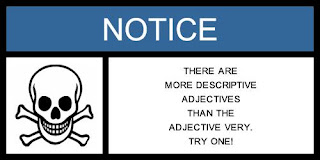
I used the Warning Label Generator, which I found the link to on the excellent social media site Mashable, to create this warning label for my students. What better way to caution them against using the adjective very then to attach it to a skull and crossbones. I'm creating additional graphics to post on various Blackboard pages. That should get their attention.
There are several easy steps to create a graphic like this.
Step 1: Choose a warning label such as Warning, Caution, Danger, Think, Be Careful, Safety First, Safety Notice, or just plain Notice.
Step 2: Choose one of over 40 symbols. There are some really fun ones. I can't wait to use Godzilla grabbing an airplane.
Step 3: Type in your warning.
Step 4: Click "Generate Warning Label."
Step 5: Right click on the graphic and hit "Save As" to save it onto your hard drive.
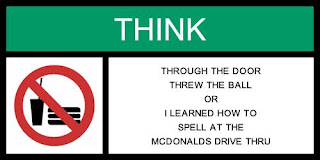
The next warning label I'm going to post will address one of my biggest pet peeves at a writing instructor:
Tuesday, August 25, 2009
Top 5 Grammar Girl Podcasts that Every Freshman in College Should Listen To
I love Grammar Girl's Quick and Dirty Tips for better writing. Her podcasts are awesome: so helpful and informative. As school starts this fall, I decided that a blog post with five great links podcasts and transcripts that cover some of the most common errors I see in student work would be in order.
- Comma Splice. If you ask a group of student what a fragment or a run-on sentence is, there's a good chance they can describe one to you, but ask 'em about a comma splice, and there's a universal blank that sweeps across their faces. So what's a comma splice? It's basically a run-on sentence with a comma seperating the two main clauses that run together. I guess they're hard to identify because there are so many reasons to use a comma, so there's not an obvious test to check for them during the editing process.
- Which versus That. Another area of contentions in student writing is the use of that verses which. I have found that most students use that correctly when they use it, but that it is not uncommon to mistake which for what should be that. Grammar Girl does a wonderful job explaining the difference by defining the restrictive that modifier, which is needed for the sentence to make sense, and the nonrestrictive which modifier, which can be left out and have the sentence still make sense. Another issue in the that/which debacle is punctuation. Just remember punctuation isn't necessary with restrictive modifiers (that), but is necessary with nonrestrictive modifiers (which), which can be left out of the sentence.
- Active Voice versus Passive Voice. Okay, so this isn't a common-error issue; however, I would be remiss if I ignored students' tendency to be overly wordy by using passive voice in their writing. To create clear and direct sentences, instructors typically prefer active voice in academic writing.
- How to Use Parallel Construction Correctly. Understanding parallel structure comes in handy in writing. It helps clarify your statements and has a pleasing rhetorical effect on the reader.
- Top Ten Grammar Myths. This podcasts debunks common myths about the use of language. Do you think that a run-on sentence is a really long sentence? Have you ever been told not to start a sentence with the word however? Do you use the word irregardless? These and many other questions will be answered in this podcast.
Tuesday, July 14, 2009
Weeks 4, 5 and 6

Wow! Is it really week 6? It seems like just yesterday I was lamenting over week 3. So why haven't you hear from me since week 3? That's easy: I'm stinking busy!
The past three weeks have been a balancing act and in some respects, I seem to be on the losing end. I have 20 students between two sections for College 3 and it seems as if the workload is heavier than it was last time I had 20 students. The grading for this class is extremely time consuming and at times, tedious. Don't get me wrong, I love what I do for this class. It's just that when I'm in a time crunch, it's hard to enjoy the process.
Meanwhile, only about half of my English 1102 class is on board. This keeps grading at a minimum, but it almost seems harder to work with fewer students. I put so much mental energy into re-orienting myself to what's going on in the class, only to have a few assignments to grade.
There's been quite a learning curve here, even though I've been teaching online for five years at other colleges. The actual course I'm using was laid out differently than how I typically put classes together, which perhaps makes a difference in how students approach the class.
For example, typically I organize the class by week; whereas, this class is arranged by projects. It seems like a no-brainer to enter each project and complete the steps, and yet, it isn't happening. I think some of this may be because if a student gets behind, he or she gets lost. I thought I headed this off with an "Assignments" tab that lists all the assignments that need to be complete, but since I'm not seeing the results I'm expecting, I have to take into account that students might not be getting it.
Another thing I'm considering is that at College 1, online classes are a way of life and students tend to take them every term, so they have more experience. At College 3, I'm working with masters-level students, so they're just more academically mature.
At College 2, however, it seems like most of my students do not have experience with classes that are exclusively online. Couple this with the fact that most are transfer students trying to get the class "out of the way at the local community college," and that pretty much equals: Care about this class? Not so much!
I sent out an email last week expressing my concerns about the lack of work I was receiving and magically those blessed green boxes started to appear in the grade book, so it's becoming apparent who is serious about the class and who is wasting tuition money.
Summer school is tough.
Shortened classes are tough.
Online classes are tough.
Combine the three: crazy/tough.
We're all hanging in there together. There are a lot of things I'd do differently next time.
Related Links
Monday, June 29, 2009
Week 3 for English 1102 on Blackboard

Well, we're a third of the way through the class already. Summer is sure flying by. I'm used to teaching in 10- or 12-week chunks, but 8 is pretty crazy.
And yet, I'm feeling pretty lonely this week when it comes to my online class.
As I look at the curriculum, I wonder if there are just too many short assignments and if the workload from week to week fluctuates too much. When teaching online, consistency from week to week has been the key to success. If students know that every week will involve a reading, a discussion, and an assignment, there should be no problem. Right? This class takes on a different approach than anything I've ever taught online before.
As I elaborated on and tweeked the course shell I was given for the class, I naively reminded myself that anyone who registered for this class should understand that the six hours a week they're not spending inside the classroom should be applied to their own schedule online throughout the week.
I think the class is intuitively laid out. Students are brought through the course item by item, so you'd think they'd just move through the curriculum and not miss a beat. Yet there are so many outstanding assignments, it's hard not to be discouraged. Where are my students? Why aren't they online six hours a week?
How is a student supposed to function within an online class unless they're, well, online. Student's attend class through their participation, and so while the traditional large chunks of time that a shortened, face-to-face class demand (like Tuesday and Thursday morning from 8 AM 'til noon, and no, there is no bathroom break), an online class demands shorter chunks of time with greater frequency of attendance (say, 30 minutes a day, 5 days a week--and that's just being online to participate in discussions.)
I've had the entire week to think about this as I also wondered if students my are gauging the point value of this week's assignments with the value of the overall class. As an educator, it's annoying to think that students are cutting corners and not taking in the depth of my knowledge and preparation, which undoubtedly, if taken advantage of, will yield a group of excellent writers ready to tackle any research project, paper, or essay exam that comes their way.
But then I think of my own college days, when I'd look through the syllabus to see how many classes I could cut without being penalized and weigh that against the busy lifestyle of the 21st century college student, who likely works more hours than I did and may possible have kids and other distractions/obstacles or whatever you want to call them interfering with their ability to get everything done.
After all, as a mother of two little kids who is teaching five classes at three different colleges this summer and maintaining two blogs, how can I not relate?
And that's education in the 21st Centruy . . . and week 3 of my 1102 class.
Wednesday, June 24, 2009
Mr. Busypants Isn't the Only Kindergartener That Podcasts
I ran across this article/video about Kindergarteners podcasting through my Google Alerts and I thought to myself, well, this is old news. See, in my rush to prepare for my English 1102 online class at College 2, I discovered podcasting. And as I podcasted, I thought about Mr. Busypants and his knack for the spotlight. The next thing I knew, were were both podcasting.
XML


While we recorded many of his books via podcast, the first to be published online on The Adventures of Mr. Busypants was Dinosaur Book.
Related Posts
Might as Well Face It, I'm Addicted to Podcasting
Week 1 for English 1102 on Blackboard
5 Great Web Resources to Enhance Learning
Using Google Alerts to Enhance Research
XML
Tuesday, June 23, 2009
Need a Documentary Now? Search from over 700 Documentaries Available Free at SnagFilms

Need a Documentary? You can choose from 700 documentaries available free through SnagFilms. This website both offers full versions of documentaries from new and already-established film makers and makes it easy to "snag" a film and publish it on the web.
According to its website, SnagFilms "can be summed up in four words: Find, Watch, Snag, Support." So when you go on the site, search for a documentary that interests you, watch it online, publish the film's widget on your blog or website for others to see, and check out the charity-related link provided to support an organization related to the documentary.
As you browse the site, browse tabs and links to find "What's Hot." You'll find links to the newest, most popular, top rated, and most discussed documentaries on the site. You may also browse by topics such as Campus, Environment, Health, History, International, Life & Culture, Music & Arts, Politics, Religion & Spirituality, Science & Nature, Sports & Hobbies, and Women's Issues.
Check out this the link to the documentary American Dream to see how a blogpost snagged from Snagfilm looks like.
Wednesday, June 17, 2009
My Journey with Gmail
I discovered Gmail after becoming increasingly annoyed with using Yahoo Mail. I was being spammed to death and I needed something new.
Enter Gmail.
I started with an address that mirrored my Yahoo address, then invited my entire address book to start using this new account. Next, I created my mr.busypantsadventures@gmail.com address. I attach this address to my Blogger account, so whenever someone email me through Blogger, I know exactly where it came from because each subject line came with the mr.busypants email address as a label right before the subject line.
In addition to blogging, I spend a lot of time online teaching writing and literature at three Chicago-area colleges. While I was having tremendous success managing my personal email, it frustrated me to have to check so many other email accounts regularly.
To alleviate this pressure, I created separate Gmail accounts for each college. The naming convention I used was: school initials (dot) my last name @ gmail.com. Next, I went into the settings page on each account, clicked on the Accounts tab, and added the address both to "Send mail as:" and "Get mail from other accounts."
I only use my email account for College 1 for the occasional outgoing messages that need my official email. All email in that account is forwarded directly to my college1.anderson@gmail.com account.
College 2 requires me to use my assigned email account, so I give my students the gmail address I created for that school. Then I set "Rules" in the College 2 email account that forward all emails from specified addresses (like the dean's and other important people in my department and others I coorespond with regularly) and specified key phrases (like English 1102, online classes, and Blackboard.) I still check this email pretty regularly, but the important stuff gets through more quickly and is not missed in the endless emails I receive that I delete after reading the subject.
As for College 3, I don't have many students , and it makes sense to use my college-given account. I don't get that much email to that account that I want to check it several times a day, so I have all email from that account forwarded to my Gmail account. That way I know when to check that account and respond accordingly.
Now I essentially have five separate email accounts going into one inbox: one personal, one blog, and three school. Each email I receive from another account has a label specific to that account, so it's easy to scan my inbox for email from each school. Once I've done with an email, I label it, file it, and I'm done with it.
Enter Gmail.
I started with an address that mirrored my Yahoo address, then invited my entire address book to start using this new account. Next, I created my mr.busypantsadventures@gmail.com address. I attach this address to my Blogger account, so whenever someone email me through Blogger, I know exactly where it came from because each subject line came with the mr.busypants email address as a label right before the subject line.
In addition to blogging, I spend a lot of time online teaching writing and literature at three Chicago-area colleges. While I was having tremendous success managing my personal email, it frustrated me to have to check so many other email accounts regularly.
To alleviate this pressure, I created separate Gmail accounts for each college. The naming convention I used was: school initials (dot) my last name @ gmail.com. Next, I went into the settings page on each account, clicked on the Accounts tab, and added the address both to "Send mail as:" and "Get mail from other accounts."
I only use my email account for College 1 for the occasional outgoing messages that need my official email. All email in that account is forwarded directly to my college1.anderson@gmail.com account.
College 2 requires me to use my assigned email account, so I give my students the gmail address I created for that school. Then I set "Rules" in the College 2 email account that forward all emails from specified addresses (like the dean's and other important people in my department and others I coorespond with regularly) and specified key phrases (like English 1102, online classes, and Blackboard.) I still check this email pretty regularly, but the important stuff gets through more quickly and is not missed in the endless emails I receive that I delete after reading the subject.
As for College 3, I don't have many students , and it makes sense to use my college-given account. I don't get that much email to that account that I want to check it several times a day, so I have all email from that account forwarded to my Gmail account. That way I know when to check that account and respond accordingly.
Now I essentially have five separate email accounts going into one inbox: one personal, one blog, and three school. Each email I receive from another account has a label specific to that account, so it's easy to scan my inbox for email from each school. Once I've done with an email, I label it, file it, and I'm done with it.
Tuesday, June 16, 2009
5 Great Web Resources to Enhance Learning
Using the Internet to enhance the classroom experience is almost a must in 21st century learning. Here are five great ways engage students online and in the classroom.
Create a Class Wiki
Looking for a fresh way for students to work collaboratively? Why not create a class wiki. As a writing instructor, I love to bring my own interests into the classroom. One thing I love are movies. Recently I decided I needed a fresh way to write about film in a Freshman composition class. It all started with the use of a typical assignment I'd given over the years: to watch the film Rebel Without a Cause and write a character analysis. Students at College 2 found this assignment challenging as they they didn't have much experience writing an analytical, literary analysis. This came as kind of a surprise to me, as at College 1 dealt with this kind of assignment pretty regularly. As a way to better reach my students with this kind of assignment, I created a Class Wiki project.
After watching and thoroughly discussing Rebel Without a Cause, students were asked to choose their own film along the theme of teen drama--another love of mine. I then created a site on Wetpaint called Writer's Workshop.
The assignment: as a group, create a wiki page highlighting a teen drama. Students were asked to write a brief plot summary, three-five character analyses (depending on how many people were in the group), and a theme analysis. They were responsible for dividing the writing responsibilities, adding visual content (pictures, video clips, music, etc), and editing each other's work.
This assignment is unlike a typical group assignment in that every student is accountable in two ways: 1) they're required to turn in a one-page summary/analysis of their participation in the project, and 2) their work online is tracked on the wiki itself, so the content they add and edit is easily tracked.
After using this assignment for two semesters now, I have heard from many students that this was their favorite project for the course. More than half of my students stated that they were incredibly motivated to participate, enjoyed the process, and learned a lot about group dynamics.
Create a Class Wiki
Looking for a fresh way for students to work collaboratively? Why not create a class wiki. As a writing instructor, I love to bring my own interests into the classroom. One thing I love are movies. Recently I decided I needed a fresh way to write about film in a Freshman composition class. It all started with the use of a typical assignment I'd given over the years: to watch the film Rebel Without a Cause and write a character analysis. Students at College 2 found this assignment challenging as they they didn't have much experience writing an analytical, literary analysis. This came as kind of a surprise to me, as at College 1 dealt with this kind of assignment pretty regularly. As a way to better reach my students with this kind of assignment, I created a Class Wiki project.
After watching and thoroughly discussing Rebel Without a Cause, students were asked to choose their own film along the theme of teen drama--another love of mine. I then created a site on Wetpaint called Writer's Workshop.
The assignment: as a group, create a wiki page highlighting a teen drama. Students were asked to write a brief plot summary, three-five character analyses (depending on how many people were in the group), and a theme analysis. They were responsible for dividing the writing responsibilities, adding visual content (pictures, video clips, music, etc), and editing each other's work.
This assignment is unlike a typical group assignment in that every student is accountable in two ways: 1) they're required to turn in a one-page summary/analysis of their participation in the project, and 2) their work online is tracked on the wiki itself, so the content they add and edit is easily tracked.
After using this assignment for two semesters now, I have heard from many students that this was their favorite project for the course. More than half of my students stated that they were incredibly motivated to participate, enjoyed the process, and learned a lot about group dynamics.
Google Docs
After teaching writing for eight years, I still found it difficult to teach students about revision. Then College 3 introduced me to using Google Docs to teach revision. At College 2, I developed a revision assignment that students worked on weekly for four weeks. Each student created a Google account and uploaded their first paper onto Google Docs. They then shared their document with me so we both had access to it. Each week, I'd give students a new way to revise their papers: for punctuation, for word choice, for sentence structure, etc.
They also wrote a journal at the bottom of the document explaining what changes they either made or contemplated, or why they decided not to make any changes. This gave them an opportunity to reflect on their own writing process. After students made the assigned revisions for the week, I'd give them feedback and specific pointers. By making revision four separate assignments during four different classes, students got a feel for how to revise more extensively, reading their paper differently depending on what they were working on.
Google Alerts
If students are already logged in to a Google account, using Google Alerts is easy. With Google alerts they can create a search for a research topic, choose the types of websites they'd like results from, allocate how often they'd like to receive an alert (as they come, daily, weekly, etc), and assign an email address to which alerts will come.
For students doing research, this is a great way to generate ideas and possibly even sources. Links to news sites, websites, blogs, video sites, and groups related to specific searches are sent directly to email.
Podcasting
Making a verbal connection with online students is essential to their success. The more connected students are, the more likely they are to complete their assignments, interact on discussion boards, email the instructor with thoughts, suggestions, and questions, and succeed in an online course.
Podcasting is made easy through Audacity, which provides free, open source software that allows users to record and edit their own podcasts. Then either load podcasts onto Blackboard or find a free podcasting host site the podcast.
Blogs
When I teach writing a narrative, I like to teach by example. I do this by introducing students to my blog, The Adventures of Mr. Busypants, and providing commentary on my own writing process. This works well because students get to see me not just as a teacher, but as a writer. This especially helps build that personal connection that helps motivate students to care about what they're learning. I also invite students to give me feedback so that I may improve on my own writing.
How do you use the web-based resources to enhance the classroom experience?
Related Links
Week 2 for English 1102 on Blackboard
Teaching Online Blog is a Good Read for Online Instructors
Might as Well Face it I'm Addicted to Podcasting
Need a Documentary Now? Search from over 700 Documentaries Available Free at SnagFilms
Friday, June 12, 2009
Week 1 for English 1102 on Blackboard

Well, I've just completed Week 1 of my first online class at College 2 and I have to say, I'm pretty excited. First off, every student has now successfully logged in and started their assignments. Several are completely in sync with what's due, although I'm giving a little slack this week because the week 1 assignments are so tied to the book, which some are still waiting for from Amazon.com.
Some things I've done to ensure a successful start include:
Announcements
I posted an announcement, which I also emailed students over the weekend, inviting them to check out the course. I will also post weekly announcements reminding them about what's coming up.
Staff Information
I made the course inviting by posting my picture under staff information. It's the same one I use for my blog. Hopefully they'll see that I am human and that English doesn't have to be that scary or painful. Since I'm adjunct and I pretty much never check my voicemail, I included a cell phone number. We'll see how this goes. I tried this with College 3 and so far, the privilege has not been abused.
To mix things up, I added two teaching assistants to my staff list: my six-year-old son and his two-year-old sister. I added fun notes from each of them, which I hope fill add personality to the course. I want my students to see me not only as an expert in writing, but also as a person who cares about theirs. What better way to do this then to add some fun features that distinguish my online course from another?
My son Alex, aka Mr. Busypants "writes": My desk is situated right next to my mom's in our office. I work with her constantly and interrupt her whenever necessary. You can read about me at The Adventures of Mr. Busypants. I post my best artwork on Mondays. Click on the slideshow on the right to see examples of why I'm called Mr. Busypants.
As for my daughter, Jorie, aka Miss Chattyshoes, she "writes": If my mom isn't answering your emails, I am probably the reason. I demand attention all day long and if I even think I might not get it, I will throw myself on the floor and scream. You can read about me on The Adventures of Mr. Busypants every Tuesday in my supposed-to-be-weekly column Tuesdays with Jorie.
Discussion Boards
The primary work of week 1 was to participate on the discussion boards. The first board asked students to introduce themselves. I made sure I had a post as well and checked in several times a day to see who accessed the course. I also tried to respond to each student with some kind of connection, whether it be to the town they live in or a personal interest of theirs--I looked to make a connection.
The rest of the discussions assigned for that week had to do with completing exercises for the reading. Mid-week I noticed no one had yet tackled the first exercise, so I did the exercise myself and posted my thoughts and additional encouragement and pointers. As students started to post their assignments, I again looked for ways to acknowledge or encourage them. I didn't reply to every response, but I made an effort to respond once to each student.
Podcasts
Now I must admit, I'm addicted to podcasting. It's so fun! So far for the course, I've recorded three podcasts: the first went step-by-step through my Blackboard site; it was about twelve minutes long. The second went through the course introduction, which included an explanation of all the week 1 assignments, and was three minutes long. The latest podcast, also three minutes, discussed the first project, which will span over weeks 2, 3 and 4.
In my podcasts, I made sure I encouraged students to manage their time against their work, school and social schedule and to look ahead to the next project so that no assignment sneaks up on them. There are weeks where projects overlap (for example, I told them to look at project 1 this week so they could start thinking about a research topic), so I want to make sure they're aware of this. There will also be portions of the second project that may take time to execute (like scheduling an interview with an expert), so I don't want that part of the assignment to catch them by surprise.
Not only do I plan on posting a podcast for each project, but I also plan on posting weekly check-in podcasts to stay in touch. I have a tab called Podcasts on Blackboard and I also post each podcast on the Announcements page with a link, which is also emailed to each student.
Late Log Ons
By Thursday of week 1, I noticed that one student still had not logged on (you can check a student's last access through the grade book on Blackboard.) I emailed that student to find out what the problem was and encourage him to drop the course if he wasn't going to pursue it. I heard back from him within 24 hours. He was trying to access Blackboard through his old school account. Since the school recently switched over to a new system, his Blackboard account with his live classes came from a different log in. I am happy we resolved this issue so quickly and it was in part because of that personal connection.
Email Organization
One thing that I find to be difficult with working at several different colleges is email. It's time consuming to have to regularly check several accounts, several times a day.
To help with this, I created personal gmail accounts for each college, and forwarded those accounts to my primary email. In my primary email box, each email I receive is labeled with the address it is sent to, so it's really easy to see what emails come from which college.
For College 2, I went into my school email address and set up "rules" for forwarding certain email. For example, all email from important people in my department (like the dean, her assistants, key people from the library and other areas in the college) and with specific subjects (like English 1102), to my Gmail. That way, if something important pops up in that email account, I get it a little more quickly than I would otherwise.
Well, that's about it for Week 1. I'm looking forward to an excellent semester and will keep you posted on the ups and downs of English 1102 online.
Related Links
Teaching Online Blog is a Good Read for Online Instructors
Might As Well Face It I'm Addicted to Podcasting
Using Google Alerts to Enhance Research
My Journey with Gmail
5 Great Web Resources to Enhance Learning
Subscribe to:
Posts (Atom)


