Prep for an online class doesn't end once the course is initially complete and delivered that first time. As in the traditional classroom, there's always room for improvement. Every act of preparation requires time and effort. It's not like in the f2f classroom, where you can come up with an idea on the fly and give it a try to see if it works. Every act must be intentional and the steps for each act must be carefully planned and prepared.
Every semester I choose one thing to improve, even if there are a gazillion things that need help. Because of the time commitment, I find that any improvement I make needs to be ready before the class starts because once that happens, all my time goes into my students.
This this current semester, for example, I took something I learned delivering the curriculum from the masters-level academic writing course I teach, and incorporated into my undergrad composition class.
In the graduate-level class, students journal about what they read and start to connect the theories of the readings into practice in their writing. One thing I noticed about the online freshman composition class I teach, is that there is no grammar component in the class. My masters-level students have often lamented in their journals that the grammar and style concepts they were learning should have been taught to them in undergrad. Knowing this, I decided to transfer this concept to my freshman, hoping that they'd see a benefit in journaling about what they read. While there are still many changes I'd like to make to the course, this was the change I thought would be most beneficial to my students, so I went with it. If it's successful, I'll leave it in the curriculum, and if it's not, I'll either modify it or discontinue this exercise.
Another improvement I'd like to make in my online classes is to add weekly podcasts to the announcements. Preparing podcasts can be extremely time consuming. Personally, I can't just sit down and record--I need to write a script first. I record using Audacity, which allows me to edit out any bumbles I make. So far, the majority of my podcasts have been introductory to give students another way to get to know me as an instructor. One summer semester, I recorded a podcast for each week. I'm not sure how effective they were, or how necessary, but for some students, hearing instructions in addition to reading them can be beneficial.
Composition classes are scary for many students, so I like to convey an open and relaxed atmosphere to empower students to write instead of worrying how I'm going to react to their writing. I would like to create more effective assignments and podcasts in the future to further enhance my current curriculum.
Thursday, April 8, 2010


Monday, April 5, 2010
What is Online Learning and How Much Easier is it Than Face to Face?
A key ingredient for online learning is MOTIVATION. Because students don’t have to be at a specific place at a specific time, it’s easy for them to forget the online class exists. I recently read a blog post on Teaching Online where the virtual professor talked about adult learning environments being “learner-centered education that guides learners to be self-directed and independent in their learning.” The desired end result in such an environment is that students and teachers become equal partners in the learning process. This to me is a perfect description of online learning
Sometimes students don't realize how reading- and writing intensive online classes are. Students need to self-evaluate to determine if this format will work for them.
One way to change the perception that online=easy is for instructors to be clear and up front about the time commitment necessary and how the way one operates in an online setting is totally different than the traditional classroom.
When instructors are clear about their expectations, serious students will be motivated to think about their schedule and how they will fit the level of interaction necessary to succeed into what is likely a pretty busy lifestyle.
I, for one, am often at the mercy of my kids and my students (and my husband, and the laundry/dishes/house, and the kids a little more). It's kind of scary to be committed to teaching and taking an online class because there will be days (like today) where I can cyber stalk the discussion boards, but there may be others where I'm so busy that I miss that 48 hour window.
Do how do students/teachers get organized?
One of the first things I tell my online students is to get a calendar and write down due dates for all assignments for not only my course and their other courses, but also their other commitments in life. There's a healthy population of young adults out there who don't know how to manage a calendar.
Weekly announcements help as well. I try to be friendly and conversational in them as I remind them of the week's due dates and to look ahead to next week.
This will not guarantee a student will be successful in an online course; however, being clear about expectations and helping students get organized are two important factors in achieving success in an online class.
Sometimes students don't realize how reading- and writing intensive online classes are. Students need to self-evaluate to determine if this format will work for them.
One way to change the perception that online=easy is for instructors to be clear and up front about the time commitment necessary and how the way one operates in an online setting is totally different than the traditional classroom.
When instructors are clear about their expectations, serious students will be motivated to think about their schedule and how they will fit the level of interaction necessary to succeed into what is likely a pretty busy lifestyle.
I, for one, am often at the mercy of my kids and my students (and my husband, and the laundry/dishes/house, and the kids a little more). It's kind of scary to be committed to teaching and taking an online class because there will be days (like today) where I can cyber stalk the discussion boards, but there may be others where I'm so busy that I miss that 48 hour window.
Do how do students/teachers get organized?
One of the first things I tell my online students is to get a calendar and write down due dates for all assignments for not only my course and their other courses, but also their other commitments in life. There's a healthy population of young adults out there who don't know how to manage a calendar.
Weekly announcements help as well. I try to be friendly and conversational in them as I remind them of the week's due dates and to look ahead to next week.
This will not guarantee a student will be successful in an online course; however, being clear about expectations and helping students get organized are two important factors in achieving success in an online class.
Sunday, April 4, 2010
Continuing My Own Education, Part 2
Having gotten my first F2F class on the other side of the podium under my belt, I decided to pursue something more. It started with a conversation with the woman who teaches before me in the computer lab on Thursday nights. JJ and I have about 40 minutes each week to shoot the breeze about English 1101 and other teaching topics between class meetings.
JJ told me about the Illinois Online Network, where I can pursue a Master Online Teacher Certificate where else but online. What is particularly cool about this program is because I'm a part of the College of DuPage faculty (a COD faculty member helped design this program), tuition is only $60 per class.
In this program, I will take four core classes that are fully online and 8-weeks long. There's also one elective and a practicum that needs to be completed. I started my first class, "Online Learning: An Overview," earlier this week and I'm loving it.
I've been online grading a lot this week and have more time to devote than usual, so I've been quite the over-achiever on the message boards. I hope my classmates don't think I'm a total suck-up. I'm simply deprived of conversation with other adults in my field. I've been deprived for a very long time, so I'm really enjoying connecting with my peers in the field.
I certainly don't have the time for these classes, but I'm so incredibly motivated right now that I'm MAKING the time. It's such a creative outlet for me and it's inspiring me to make time to reach my own personal writing and teaching goals instead of always focusing on the needs and goals of others. It's a nice change.
Related links: Continuing My Own Education, Part 1
JJ told me about the Illinois Online Network, where I can pursue a Master Online Teacher Certificate where else but online. What is particularly cool about this program is because I'm a part of the College of DuPage faculty (a COD faculty member helped design this program), tuition is only $60 per class.
In this program, I will take four core classes that are fully online and 8-weeks long. There's also one elective and a practicum that needs to be completed. I started my first class, "Online Learning: An Overview," earlier this week and I'm loving it.
I've been online grading a lot this week and have more time to devote than usual, so I've been quite the over-achiever on the message boards. I hope my classmates don't think I'm a total suck-up. I'm simply deprived of conversation with other adults in my field. I've been deprived for a very long time, so I'm really enjoying connecting with my peers in the field.
I certainly don't have the time for these classes, but I'm so incredibly motivated right now that I'm MAKING the time. It's such a creative outlet for me and it's inspiring me to make time to reach my own personal writing and teaching goals instead of always focusing on the needs and goals of others. It's a nice change.
Related links: Continuing My Own Education, Part 1
Friday, March 26, 2010
Continuing My Own Education
I've been teaching for nearly 10 years and I've recently gotten the go-back-to-school bug. With two young kids and a full teaching schedule, pursuing another degree is not appealing. I really don't want a doctorate in this point in my career and I can't really think of a master's program that I want to enroll in (or pay for). But recently at College of DuPage, I got an email about an opportunity to take a graduate-level class through Aurora University for $325--INCLUDING the book.
I didn't think I could ever beat that price, and the subject was of interest--teaching studentes for the workplace. So a month ago, I attended my first class.
I love it. The discussion is stimulating and the instructor is open-minded. Everything we do in this class serves a greater purpose: to apply new ways of teaching to a specific class I'm teaching. How cool is that!
Right now I'm working on a resource website that I'm creating as an assignment called the Writing Resources Toolbox. In it I'm creating links to tools and resources for my students and for other instructors.
The student section has (or will have) both a Grammar Toolbox and a Writing Style Toolbox. The toolboxes will contain links to webpages and interactive exercises to help students brush up on grammar- and style-related issues in their writing.
The instructor section is the most exciting for me and includes Social Media Resources, Google Apps Resources, Additional Online Resources, and Web 2.0 Resources. I'm also hoping to create sections for Using Blackboard Effectively and Writing Assignments.
I'm most excited about this section. Basically, whenever I'm in my reader reviewing my favorite blogs (like Teach Online, Free Technology for Teachers, and Blogging about the Web 2.0 Connected Classroom), I add a link to anything useful out there that I've been successful implementing, would like to implement, or would simply like to learn more about.
What new technologies have you implemented in the classroom--online or F2F?
I didn't think I could ever beat that price, and the subject was of interest--teaching studentes for the workplace. So a month ago, I attended my first class.
I love it. The discussion is stimulating and the instructor is open-minded. Everything we do in this class serves a greater purpose: to apply new ways of teaching to a specific class I'm teaching. How cool is that!
Right now I'm working on a resource website that I'm creating as an assignment called the Writing Resources Toolbox. In it I'm creating links to tools and resources for my students and for other instructors.
The student section has (or will have) both a Grammar Toolbox and a Writing Style Toolbox. The toolboxes will contain links to webpages and interactive exercises to help students brush up on grammar- and style-related issues in their writing.
The instructor section is the most exciting for me and includes Social Media Resources, Google Apps Resources, Additional Online Resources, and Web 2.0 Resources. I'm also hoping to create sections for Using Blackboard Effectively and Writing Assignments.
I'm most excited about this section. Basically, whenever I'm in my reader reviewing my favorite blogs (like Teach Online, Free Technology for Teachers, and Blogging about the Web 2.0 Connected Classroom), I add a link to anything useful out there that I've been successful implementing, would like to implement, or would simply like to learn more about.
What new technologies have you implemented in the classroom--online or F2F?
Thursday, March 18, 2010
Establishing Rapport with Online Students is Essential
Even though my schedule is crazed, I'm really excited about teaching this semester. I just started three new sections (two 8-week English composition courses online and one 8-week academic writing class online).
Establishing rapport with my students is my number one priority this week. It's difficult enough to take a writing class, but to do so online presents even more challenges. Many students do not feel confident about their writing, so to send it to some virtual grade book can be intimidating.
It is important to establish an online dialog with students the very first week. I do this in many ways using several venues. First of all, I start the class with a welcome email. If I can, I send it a week in advance to get students thinking about the course. Then when the course begins, I resend it to establish an official connection. I also recorded an introductory podcast, so students hear my voice and get to see me as a person. I build on this with a fun insightful instructor page, where I introduce myself and my "teaching assistants."
It is essential that during the first week of an online class, the instructor email the students 3-4 times to encourage their participation. By the first day of class, they've already heard from me twice: once inviting them for a sneak peak at the course and again the first day of the course.
The day of the first deadline (or night before), I send a reminder email to motivate students to get on Blackboard and complete their assignments. I also make grading a priority and virtually stalk the grade book so that I can review the first assignment and give feedback. While it's not essential to give feedback on all the exercises, it's important to establish a connection within those first assignments.
In my Comp 1 classes, for example, students are asked to discuss several areas of their writing. When I review their responses, I look for something to grasp onto, whether it's a way to compliment them or a way to alleviate their fears or stress. The next thing I do is review their class homepage, which is one of their first assignments for the term. Again, I search for a connection and make comments as I find them. The goal is for every student to receive feedback from me during that first week.
Another thing I do is start a discussion board right away. This semester, I am taking a graduate-level class about preparing students to write in the workplace. One of my assignments was to write an advance organizer, which consists of ten T/F questions related to the course content, ten Interesting/Boring questions as a means to touch base with each students personal interest levels, and ten Agree/Disagree questions to tap into their expectations for the course. I posted an "extra credit" (yes, I lured them with the academic equivalent to candy) discussion board to talk about the survey. Then I cyber-stalked the discussion boards looking for reasons to respond and encourage participants.
I am now at the end of my first week of eight and my final email of the week is to those who have not yet logged in to Blackboard, gently reminding them of the importance of timely participation.
I think I've don just about all I've can to engage students this week and am looking forward to seeing how my efforts pay off throughout the semester.
I'll let you know how it goes.
Establishing rapport with my students is my number one priority this week. It's difficult enough to take a writing class, but to do so online presents even more challenges. Many students do not feel confident about their writing, so to send it to some virtual grade book can be intimidating.
It is important to establish an online dialog with students the very first week. I do this in many ways using several venues. First of all, I start the class with a welcome email. If I can, I send it a week in advance to get students thinking about the course. Then when the course begins, I resend it to establish an official connection. I also recorded an introductory podcast, so students hear my voice and get to see me as a person. I build on this with a fun insightful instructor page, where I introduce myself and my "teaching assistants."
It is essential that during the first week of an online class, the instructor email the students 3-4 times to encourage their participation. By the first day of class, they've already heard from me twice: once inviting them for a sneak peak at the course and again the first day of the course.
The day of the first deadline (or night before), I send a reminder email to motivate students to get on Blackboard and complete their assignments. I also make grading a priority and virtually stalk the grade book so that I can review the first assignment and give feedback. While it's not essential to give feedback on all the exercises, it's important to establish a connection within those first assignments.
In my Comp 1 classes, for example, students are asked to discuss several areas of their writing. When I review their responses, I look for something to grasp onto, whether it's a way to compliment them or a way to alleviate their fears or stress. The next thing I do is review their class homepage, which is one of their first assignments for the term. Again, I search for a connection and make comments as I find them. The goal is for every student to receive feedback from me during that first week.
Another thing I do is start a discussion board right away. This semester, I am taking a graduate-level class about preparing students to write in the workplace. One of my assignments was to write an advance organizer, which consists of ten T/F questions related to the course content, ten Interesting/Boring questions as a means to touch base with each students personal interest levels, and ten Agree/Disagree questions to tap into their expectations for the course. I posted an "extra credit" (yes, I lured them with the academic equivalent to candy) discussion board to talk about the survey. Then I cyber-stalked the discussion boards looking for reasons to respond and encourage participants.
I am now at the end of my first week of eight and my final email of the week is to those who have not yet logged in to Blackboard, gently reminding them of the importance of timely participation.
I think I've don just about all I've can to engage students this week and am looking forward to seeing how my efforts pay off throughout the semester.
I'll let you know how it goes.
Wednesday, March 17, 2010
Saturday, January 30, 2010
Using the Subscribe Feature on Blackboard
This school year I have found myself teaching more classes than ever. With the economy being as it is, it's hard to pass up work--especially when my husband may not have a job for much longer.
With all these extra classes, additional measures of organization have had to be made as well. I have this awesome master list on Microsoft OneNote that has put the organizational aspects of teaching on autopilot. (But that's another blog post entirely.)
One of my biggest weaknesses in online instruction is keeping up with the discussion boards. It's tough, because as much as I want my students to use them to participate in class, when I go into the boards a couple of times a week, I become overwhelmed with all the reading and find it difficult to actually particpate in the discussion.
I remember at the last Blackboard training I went to that there was an option for a subscriptions, so I started exploring how I could implement that tool. Here's what I found:
Go to the "Discussion Board"
Click on "Modify" next to the forum you wish to enable subscriptions to.
Under 3: Forum Settings, scroll down to the Subscribe menu.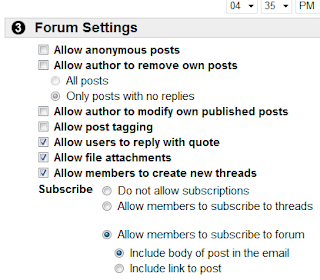
With all these extra classes, additional measures of organization have had to be made as well. I have this awesome master list on Microsoft OneNote that has put the organizational aspects of teaching on autopilot. (But that's another blog post entirely.)
One of my biggest weaknesses in online instruction is keeping up with the discussion boards. It's tough, because as much as I want my students to use them to participate in class, when I go into the boards a couple of times a week, I become overwhelmed with all the reading and find it difficult to actually particpate in the discussion.
I remember at the last Blackboard training I went to that there was an option for a subscriptions, so I started exploring how I could implement that tool. Here's what I found:
Go to the "Discussion Board"
Click on "Modify" next to the forum you wish to enable subscriptions to.
Under 3: Forum Settings, scroll down to the Subscribe menu.

Choose to allow subscriptions to threads or forums. If you choose to include forums, decide whether or not you'd like the subscription email to include the body of the post or just a link to the post.
Having subscribed to all my discussions, I'm looking forward to seeing how much more efficient I am with participating on the discussion boards.
Related links: Technology Teacher: Blackboard Discussion Board Features
Saturday, January 9, 2010
25 Tools: A Toolbox for Learning Professinals 2009
I came across this great resource on Slideshare posted by Jane Hart, a social learning consultant and founder of The Centre for Learning and Performance Technologies.
Friday, August 28, 2009
Warning Label Generator Can Be Very Effective in Reaching Students
When I was a freshman in college, my composition teacher, Mary Daly, insisted that we never use the word very in our writing because
it was a dead adjective that didn't describe anything. I still find myself using the word in my writing, but because of Mary, whenever I do, I am prompted to think of a more descriptive adjective.
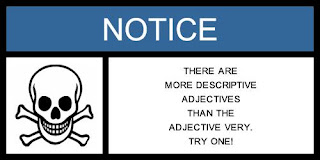
I used the Warning Label Generator, which I found the link to on the excellent social media site Mashable, to create this warning label for my students. What better way to caution them against using the adjective very then to attach it to a skull and crossbones. I'm creating additional graphics to post on various Blackboard pages. That should get their attention.
There are several easy steps to create a graphic like this.
Step 1: Choose a warning label such as Warning, Caution, Danger, Think, Be Careful, Safety First, Safety Notice, or just plain Notice.
Step 2: Choose one of over 40 symbols. There are some really fun ones. I can't wait to use Godzilla grabbing an airplane.
Step 3: Type in your warning.
Step 4: Click "Generate Warning Label."
Step 5: Right click on the graphic and hit "Save As" to save it onto your hard drive.
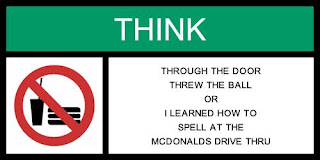
The next warning label I'm going to post will address one of my biggest pet peeves at a writing instructor:
Tuesday, August 25, 2009
Top 5 Grammar Girl Podcasts that Every Freshman in College Should Listen To
I love Grammar Girl's Quick and Dirty Tips for better writing. Her podcasts are awesome: so helpful and informative. As school starts this fall, I decided that a blog post with five great links podcasts and transcripts that cover some of the most common errors I see in student work would be in order.
- Comma Splice. If you ask a group of student what a fragment or a run-on sentence is, there's a good chance they can describe one to you, but ask 'em about a comma splice, and there's a universal blank that sweeps across their faces. So what's a comma splice? It's basically a run-on sentence with a comma seperating the two main clauses that run together. I guess they're hard to identify because there are so many reasons to use a comma, so there's not an obvious test to check for them during the editing process.
- Which versus That. Another area of contentions in student writing is the use of that verses which. I have found that most students use that correctly when they use it, but that it is not uncommon to mistake which for what should be that. Grammar Girl does a wonderful job explaining the difference by defining the restrictive that modifier, which is needed for the sentence to make sense, and the nonrestrictive which modifier, which can be left out and have the sentence still make sense. Another issue in the that/which debacle is punctuation. Just remember punctuation isn't necessary with restrictive modifiers (that), but is necessary with nonrestrictive modifiers (which), which can be left out of the sentence.
- Active Voice versus Passive Voice. Okay, so this isn't a common-error issue; however, I would be remiss if I ignored students' tendency to be overly wordy by using passive voice in their writing. To create clear and direct sentences, instructors typically prefer active voice in academic writing.
- How to Use Parallel Construction Correctly. Understanding parallel structure comes in handy in writing. It helps clarify your statements and has a pleasing rhetorical effect on the reader.
- Top Ten Grammar Myths. This podcasts debunks common myths about the use of language. Do you think that a run-on sentence is a really long sentence? Have you ever been told not to start a sentence with the word however? Do you use the word irregardless? These and many other questions will be answered in this podcast.
Friday, July 24, 2009
Google Reader 101
Ever see that orange RSS logo on a website and wonder "what's the deal with all these logos?" Been there. But I learned quickly that when you hit the button, you subscribe to the website in what's called a reader. There are a variety of readers available on the web, but since I'm a Google Girl, I subscribe to all my sites in Google Reader.
It's great. I can get updates from a variety of websites, pick and choose which sites I actually want to visit, and skim posts for the ones I actually want to read.
Once you start subscribing, you'll likely find that there's a lot of great stuff out there. It may then become necessary to organize your stuff. Google Reader allows you to do this by placing your subscriptions into folders.
I started using Google Reader soon after I set up my blog The Adventures of Mr. Busypants. At first, I subscribed to other mom blogs about autism. Then I branched out into other mom blogs. Next, because I want to publish someday, I started to subscribe to publishing and writing sites. More recently, I tapped into my love for teaching and have subscribed to countless teaching blogs.
One thing I love about having a reader is it keeps me connected to other bloggers. It's also a quick way to check out a bunch of blogs to see what you want to read at a particular time. If I'm not interested or know I don't have time for the blog, I simply scroll past it on my reader. If I decide it's something I want to review later, I check "Keep unread." If I really love the post and want to keep it handy, I star it. And if I want to share it with a blog buddy, I either hit "Share" or "Share with comment" if I have something additional I'd like to add. I can even email posts to others or to myself.
Once I started subscribing to blogs, I found that my reader became one long list of things to read. I'd open it up and panic that I had 200 items to review. It got a little overwhelming, so I created categories and assigned each site I read to a particular category.
For example, when I come across a new author who writes about things similar to what I write, I subscribe and put them in my "Author Blog" folder. Any site, discussion board, or blog that deals with autism either goes into "Autism" or "Autism Blog." I also subscribe to several Bible related sites, so those sites get filed under "Bible." All the general blogs I subscribe to go under "Blogs" although they may be better suited for a section called "Mom Blogs" since those are my people.
There's a "Blogging" section for subscriptions to blog carnivals, blog design sites, and my favorite blogging and social networking advice sites, ProBlogger and Mashable. In fact, one of the current stories on Mashable is Google Reader Gets a Social Makeover, Adds Likes and Followers. I'll mark that unread and save for later.
I have a section for each niche I'm interested in: "Publishing," "Writing," and "Teaching." There's also a section of unfiled sites, but when I click "Manage Subscriptions" at the bottom of the roll, I'll be able to easily categorize each unfiled site.
As I'm writing this post, I'm exploring reader more in-depth to be sure I haven't missed anything. Here's are some additional functions I've discovered:
- I can take a look at all the items I share with others (including notes if I made any) by clicking on "Notes" in the upper left region of the page.
- People can follow my reader and I can follow theirs. When we do this, the items we click on to share become accessible to everyone on our share list.
- There are additional share functions found under "Share Settings." I can choose to share a link to my Google profile, customize my reader URL, and find people sharing in Reader.
- That there's WAY more to Google Reader than I could even imagine and that I need to spend more time exploring and create a Google Reader 102 post later.
Related Articles
Thursday, July 23, 2009
Easy Screen Captures Anyone?

I must give credit where credit is due. I was reading a post in my reader from the Free Technology for Teachers site, and I came across this post that included one AWESOME web tool that you don't want to go without: Aviary.com.
Aviary.com allows users to capture any webpage with one easy step. Just add Aviary.com/ in front of any URL and boom, your screen shot is captured. You then have the option to edit and crop your shot, and save it as a pic to your desktop.
I tried it out immediately, but adding the Aviary url to my Mr. Busypants blog address:
http://mamabusypants.blogspot.com is my URL.aviary.com/http://mamabusypants.blogspot.com is the URL that led me to a screenshot to my blog.

Then I simply cropped what I wanted, the header, and saved to my desktop.
Click here for their instruction page.
Related Links
A Very Simple Way to Make Screen Captures
A Very Simple Way to Make Screen Captures
Wednesday, July 22, 2009
One Comment a Day Project
I love my Google Reader. I've connected to so many bloggers that I might not otherwise revisit as often as I do without the fabulous technology of a reader. Recently, I read a post from Steven at Blogging About the Web 2.0 Connected Classroom, that talked about a project created by another blogger, Andy, at iTeach called One Comment a Day.
The premise is simple (and copied and pasted from Andy's site):
Here is the process.
1. Read a blog
2. Post a comment that is insightful and constructive.
3. Tweet a link to the blog and your comment. Use the hash tag #OneComment
EXAMPLE: I just read a great piece on iTeach blog, check it out! #OneComment
4. Bookmark the blog and return to it another time.
It is just that easy! This Project will help create a positive forum for all who blog and comment. There are so many good educational blogs out there and I look forward to hearing your feedback and engaging in your comments!
The second phase of this project will be a featured blog a week project. This forum will review and promote one educational blog per week. It will also try and introduce new edu-blogs into the learning community. I will be setting up a Ning for this venture. The sole purpose of both ventures is to promote learning and create an engaging dialogue between so many great academic minds. The twitter hash tag for this will be #1Newblog
Please send me your thoughts, suggestions and feedback on both new ventures!I would also like to put together a small team to help with this venture due to the time consuming nature of the project. If you would like to help your fellow bloggers and be an integral part of this venture, please contact me at onecommentproject@gmail.com
I have also set up a separate twitter account for this second phase. It will be @1commentproject. Please follow it for blog updates and blog promotions. When we spread the word about great blogs, we all shine!
I would be looking for help with the following:
1. Finding new blogs
2. Posting Reviews of Blogs
3. Archiving a Blog roll on the Ning
4. Monitoring the Ning
I am very passionate about this project and am putting a lot of time and energy behind it. My belief is that we can all learn from each other and have endless technologies to help us collaborate! I really hope to see my PLN jump on board with me and help promote the edu-blogging community!
So join me, won't you, in using the web to share teaching best practices and encouraging others in our profession. And don't forget to customize and select colors for your own blog badge.
Friday, July 17, 2009
How to Create Successful Blogposts: Revision
On Wednesday we discussed the planning stage of creating blog posts, and yesterday we covered the drafting stage. Let's move on to an important, but often overlooked, stage of writing: revision
Revision
When I revise, I first check the sentence-by-sentence, paragraph-by-paragraph flow of the post. I make sure I've made all the appropriate transitions to keep my reader engaged. For example, in the "Jorie Spelling" post, I wrote a lone paragraph about Jorie's nasty antics: particularly the smurf bites. I was all over the place with that paragraph, unsure where and how to connect it. I eventually decided to connect Mean Girls with Jorie's mean girl behavior before bringing the text back to the Donna Martin thread. In fact, this paragraph was written after the next two, but as I thought through my transitions and the logical progression of how I revise, I kept moving it up until it placed where it is.
After I check the post's organization, I re-read it several times, focusing on word choice. In fact, I'll continue to re-read it after its published just to be sure all the wording is the way I want it. The first thing I look at are how active my verbs are. For example, I originally wrote "there wasMean Girls, which gave me . . . " but changed it to "Mean Girls gave me." Subtle change, but those action verbs mean the difference between telling a story to the reader and showing the reader the story.
Once my verbs check out, I move on to adjectives. I try to come up with unique wordcombinations that leave my readers peeing in their pants with delight--see what I mean. Part of the reason I re-read and revise so much is I find myself so darn amusing. Seriously, I love to crack myself up and so as I write, I look for ways in which I can do just that. Adjectives bring writing to life and set authors apart from others. Why say I had a C-section when I can say Mr.Busypants was surgically removed from my uterus?
Which would you laugh at? Which would you remember?
Finally, I make it a rule to re-read the entire paragraph (and sometimes the one before it) if even one revision is made in it--every time. This may seem tedious and time consuming, but the revision process brings on those syntactical errors that you probably wouldn't make in an initial draft. It's important to read each sentence fully each time you revise to minimize these sloppy errors.
Using these techniques really help me write the best blogs I can write. The time pressure still keeps me from making them all that I want them to be, but I'm usually happy each post that I publish. I love making those unique connections that make my writing my own version of the Donna Martin original. Ah, I'm ending on yet another connection.
Thursday, July 16, 2009
How to Create Successful Blogposts: Drafting
Yesterday we discussed the planning stage; now let's move on to drafting a blogpost.
Drafting
Once I've gathered enough compatible ideas, the drafting begins. Take my "Jorie Spelling" post. The Tori Spelling connection comes from the Donna Martin character, so my love for Beverly Hills 90210 became the logical starting point. Next, the voices in my head started shouting "Donna Martin graduates," which reminded me that while Donna was portrayed as a sweetie(and Jorie portrays herself as a sweetie), she also has trouble-making abilities (like someone else I know).
I started with the paragraphs about our wardrobe drama, but soon flashed back to my favorite teen dramas. Once I started writing about those, the connections came flying; it was almost too perfect. A rare event in the life of a writer.
First, there was the reference to my all-time favorite movie, Heathers, which I almost always contrast against its 90s and 00 wannabes, Jawbreakers and Mean Girls.
Once I knew I wanted to make these films connect to Jorie's nasty side, I started looking for ways to make that happen. The first, most obvious, came as I remembered hearing that after seeing Heathers, Tori Spelling mentioned Doherty to her dad as a perfect Brenda. Connection.
Next, I looked at Jawbreakers starringRebecca Gayhart and Rose McGowan. This film was a litter harder because it's a lesser version and is lesser known. I kept thinking of McGowan's signature line: "I killed Liz. I killed the teen dream. Deal with it." Of course, I didn't want to go there with my two-year-old, and I knew my audience would probably not make the connection to just "Deal with it," so after a refresher of the film's plot, I decided there weren't any connections worth making aside from Gayhart being a former 90210er herself. Then suddenly it dawned on me that Rose McGowan actually replaced Shannen Doherty as one of the three sisters on Aaron Spelling's Charmed. Cha-Ching! Connection.
Finally, Mean Girls gave me the perfect opportunity to weave in Jorie's newly developing mean streak. Connection.
Be sure to tune in tomorrow as we discuss the final piece of the puzzle: revision. You don't want to miss this one!
Wednesday, July 15, 2009
How to Create Successful Blogposts: Part 1, Planning
Ideas tend to fly all around me. When I don't write things down, I get frustrated because I forget really great writing material. It can disappear in a second.
That's where drafting comes in handy. On both my blogs, at any given time there are 8-10 drafts in the works. They start out as outlines of topics I'd like to write about like the numerous balloon stories I have on Mr. Busypants or a list of possible Tuesdays with Jorie topics.
For example, when I came up with the Tuesdays with Jorie column, I immediately started brainstorming catchy blog titles. I already had Jorie Costanza (George from Seinfeld) and Jorie Balboa (aka Rocky) titles, but I knew there were a lot of themes that worked well with a name like Jorie.
As I type, I have an entire draft of titles just waiting for stories to match. I'm certain I will come up with great posts to go with "Jump for Jorie," (we do have a trampoline) "Jorie Gilmore," (the mother-daughter relationship) and "Give me the Jorie Details" (which I may just tie in with my recent viewing of the mystery event Harper's Island and my love for the film that resurrected teen horror genre, Scream. This I could somehow connect to Jorie's recent bout of blood-curdling screams).
In fact, I will often review this list and write notes of stories that might just go with the title. It's how I came up with my latest Tuesdays with Jorie column, Jorie Spelling: Fashion Diva. The drafting process went like this:
The Initial List
Recently I've noticed that Jorie has strong feelings about wardrobe. It's the basis of most of our arguments. As I saw these battles increasingly occurring, I started making notes on which outfits created the most drama. Eventually, I decided that because of her role as Donna Martin, fashion designer, that the Jorie Spelling title would work well with this subject.
Notes and Connections
One thing I'm constantly looking for as a writer is connections. The kid stories generate throughout the day as those writable moments occur; I write them down somewhere--anywhere. I try to carry a small notebook in my purse. Other times I have a larger spiral in my work bag. I've also been known to jot ideas down on tiny pieces of paper that I pool together into a master list. And now that I have the iPhone, as I drive, I create voice messages. I get some of my best thinking done in the car.
When looking for connections, I look for similar themes or symbols, pop culture references that work well with the subject, and timely events that pull things together well. For example, it's really rare that I would go over a day in the life. While a story that chronicles the days events can work, I prefer to look for a specific theme (like fashion and fighting), symbol (like megablocks and the toilet), pop culture reference (like my favorite teen dramas/dark comedies), or events (like the Fourth of July).
Tune in tomorrow for How to Create Successful Blogposts: Part 2, Drafting, and then again on Friday for How to Create Successful Blogposts: Part 3, Revision.
Tuesday, July 14, 2009
Weeks 4, 5 and 6

Wow! Is it really week 6? It seems like just yesterday I was lamenting over week 3. So why haven't you hear from me since week 3? That's easy: I'm stinking busy!
The past three weeks have been a balancing act and in some respects, I seem to be on the losing end. I have 20 students between two sections for College 3 and it seems as if the workload is heavier than it was last time I had 20 students. The grading for this class is extremely time consuming and at times, tedious. Don't get me wrong, I love what I do for this class. It's just that when I'm in a time crunch, it's hard to enjoy the process.
Meanwhile, only about half of my English 1102 class is on board. This keeps grading at a minimum, but it almost seems harder to work with fewer students. I put so much mental energy into re-orienting myself to what's going on in the class, only to have a few assignments to grade.
There's been quite a learning curve here, even though I've been teaching online for five years at other colleges. The actual course I'm using was laid out differently than how I typically put classes together, which perhaps makes a difference in how students approach the class.
For example, typically I organize the class by week; whereas, this class is arranged by projects. It seems like a no-brainer to enter each project and complete the steps, and yet, it isn't happening. I think some of this may be because if a student gets behind, he or she gets lost. I thought I headed this off with an "Assignments" tab that lists all the assignments that need to be complete, but since I'm not seeing the results I'm expecting, I have to take into account that students might not be getting it.
Another thing I'm considering is that at College 1, online classes are a way of life and students tend to take them every term, so they have more experience. At College 3, I'm working with masters-level students, so they're just more academically mature.
At College 2, however, it seems like most of my students do not have experience with classes that are exclusively online. Couple this with the fact that most are transfer students trying to get the class "out of the way at the local community college," and that pretty much equals: Care about this class? Not so much!
I sent out an email last week expressing my concerns about the lack of work I was receiving and magically those blessed green boxes started to appear in the grade book, so it's becoming apparent who is serious about the class and who is wasting tuition money.
Summer school is tough.
Shortened classes are tough.
Online classes are tough.
Combine the three: crazy/tough.
We're all hanging in there together. There are a lot of things I'd do differently next time.
Related Links
Thursday, July 9, 2009
Working out of the Panera Office
Moms in the 21st century try to do it all: balance a career, raising the kids from home, and keeping the household together. I'm one of those WSAHMs (working stay-at-home moms). Since my daughter Jorie, now 2, was born, I've found it increasingly difficult to balance it all. And with today's economy including a salary reduction to our budget, it's become important that I take all the work I can get.
I am very fortunate to get more work than I can take these days, and being spread so thin, it's important for me to work overtime to maintain balance in my life--and sanity for that matter.
My solution: A solid morning routine and the Panera office.
Each morning I wake up at 6 AM and start my day with my Bible study. I find that spending time with God almost magically gets my priorities for the day in line. My heart and mind become more capable of handling the day's events and I'm less irritable, stressed, and overwhelmed.
Next, I try (and only do it about half the time if not less) to workout for 20-30 minutes in the morning to get the adrenaline flowing. I always feel so much better physically after a quick workout. It's great to achieve a sense of accomplishment before the kids even wake up.
Two days a week, I schedule a babysitter to watch the kids from 9 AM to 3 PM and I work out of the Panera office. It's a great location. The dining room is large, so I can usually find a nice, quiet table next to an electrical outlet to set up shop. With a bagel and OJ for breakfast (ya gotta get something), I'm ready to tackle the day's work: grading papers, planning classes, emailing students, and whatever else is on the menu.
To accompany my laptop, I have my husband's Verizon card, so I'm sure to always have a reliable signal. I have a portable, cordless mouse that plugs in easily, and all my files on my beloved flash drive. I wheel in my office in a black, leather computer case, armed with my textbooks, papers, and, of course, my microphone in case I need to correspond with a student via Skype. I've also been known to record a podcast or two.
My assistant, the iPhone, comes with me so I can make phone calls, check my To Do List on reQall, record voice memos, or check my schedule for what's in store that week. I juggle personal tasks with iPhone applications like Shopper, where I can add to my grocery list and Lose It, where I can log in my calories.
The time I spend at Panera is precious: it's my time to get caught up and refresh so that I can be a better, more focused mom at home with my kids. I'd better hit publish and get to work: my babysitter's on the clock and I need to get to work.
Monday, June 29, 2009
Week 3 for English 1102 on Blackboard

Well, we're a third of the way through the class already. Summer is sure flying by. I'm used to teaching in 10- or 12-week chunks, but 8 is pretty crazy.
And yet, I'm feeling pretty lonely this week when it comes to my online class.
As I look at the curriculum, I wonder if there are just too many short assignments and if the workload from week to week fluctuates too much. When teaching online, consistency from week to week has been the key to success. If students know that every week will involve a reading, a discussion, and an assignment, there should be no problem. Right? This class takes on a different approach than anything I've ever taught online before.
As I elaborated on and tweeked the course shell I was given for the class, I naively reminded myself that anyone who registered for this class should understand that the six hours a week they're not spending inside the classroom should be applied to their own schedule online throughout the week.
I think the class is intuitively laid out. Students are brought through the course item by item, so you'd think they'd just move through the curriculum and not miss a beat. Yet there are so many outstanding assignments, it's hard not to be discouraged. Where are my students? Why aren't they online six hours a week?
How is a student supposed to function within an online class unless they're, well, online. Student's attend class through their participation, and so while the traditional large chunks of time that a shortened, face-to-face class demand (like Tuesday and Thursday morning from 8 AM 'til noon, and no, there is no bathroom break), an online class demands shorter chunks of time with greater frequency of attendance (say, 30 minutes a day, 5 days a week--and that's just being online to participate in discussions.)
I've had the entire week to think about this as I also wondered if students my are gauging the point value of this week's assignments with the value of the overall class. As an educator, it's annoying to think that students are cutting corners and not taking in the depth of my knowledge and preparation, which undoubtedly, if taken advantage of, will yield a group of excellent writers ready to tackle any research project, paper, or essay exam that comes their way.
But then I think of my own college days, when I'd look through the syllabus to see how many classes I could cut without being penalized and weigh that against the busy lifestyle of the 21st century college student, who likely works more hours than I did and may possible have kids and other distractions/obstacles or whatever you want to call them interfering with their ability to get everything done.
After all, as a mother of two little kids who is teaching five classes at three different colleges this summer and maintaining two blogs, how can I not relate?
And that's education in the 21st Centruy . . . and week 3 of my 1102 class.
Wednesday, June 24, 2009
Mr. Busypants Isn't the Only Kindergartener That Podcasts
I ran across this article/video about Kindergarteners podcasting through my Google Alerts and I thought to myself, well, this is old news. See, in my rush to prepare for my English 1102 online class at College 2, I discovered podcasting. And as I podcasted, I thought about Mr. Busypants and his knack for the spotlight. The next thing I knew, were were both podcasting.
XML


While we recorded many of his books via podcast, the first to be published online on The Adventures of Mr. Busypants was Dinosaur Book.
Related Posts
Might as Well Face It, I'm Addicted to Podcasting
Week 1 for English 1102 on Blackboard
5 Great Web Resources to Enhance Learning
Using Google Alerts to Enhance Research
XML
Subscribe to:
Posts (Atom)


